
How to Patch Test a Face Wash Safely at Home
Learn how to patch test a face wash safely, prevent reactions, and check for sensitivity before applying a new cleanser on your face.
Patch testing is among the least harmful methods that can be used to determine whether a new face wash can irritate your skin or not. Most individuals fail to do this step and develop either a reddish or a break out or a burning feeling. These reactions can be avoided by using a simple patch test, which reveals the response of your skin to the use of the product on your whole face. This way makes your routine safe and devoid of stress.
Patch testing would particularly be vital to individuals having sensitive, acne prone or reactive skin. Even mild products may turn out to be irritating in one way or another depending on the reactions of the skin on an individual basis. Patch testing is one of the methods that allow you to find out the issues at the initial stages of your life and prevent the long-term destruction of the skin barrier. By learning the right technique you will achieve the right results and your skin will not endure any unwarranted pain.
The Reason Patch Testing Is Necessary
Patch testing assists you in knowing whether a particular face wash has ingredients, which can irritate your skin. All individuals respond differently, and even the weakest types of cleansers may cause reddening or irritation. Patch testing will minimize the chances of complete-face irritation and it will provide you with confidence before incorporating a new product in your routine. This is a mere action that saves time, money and possible unpleasantness.
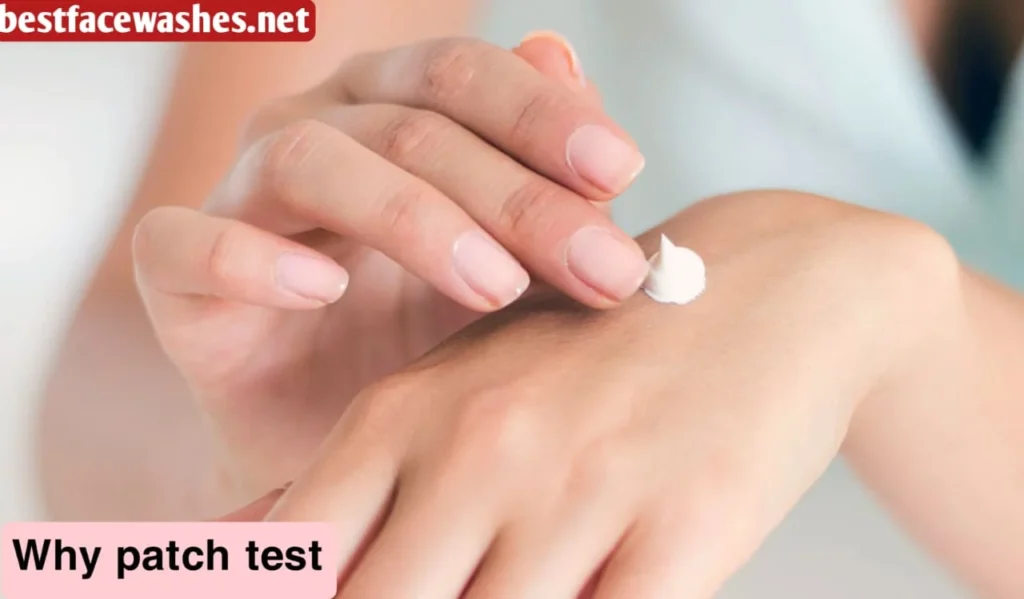
It is also beneficial in the detection of delayed reactions that occur hours following product use. Other ingredients are not immediately irritating, but they may produce sensitivity in the long term. These problems are spotted at an early stage in a patch test. Test Before full application you know that your skin is not in danger, it is not uncomfortable and is not vulnerable to any harmful reactions that may harm the barrier.
Why Patch Testing Is Important
Patch testing would best be done in areas of the skin which are thin and sensitive without being highly exposed. The usual places include behind the ear, along the jaw or within the wrist. These regions replicate facial sensitivity without causing any irritation to be seen. The selection of testing areas enhances better results and minimizes discomfort.
Testing should not be done in the areas around the eyes or lips since it is overly sensitive and could result in irritation. The fact that you observe changes by using a controlled area also helps in observing changes. Also, to make the process smoother, it is necessary to choose an appropriate testing place because in this way you will be sure that the results will be the same way your face should react to the cleanser.
Choosing the Right Area for Patch Testing
Patch testing requires the correct amount of product to be used. A pea sized lot is sufficient to test the sensitivity without saturating the skin. Using excessive amounts will be irritating even to normal skin, and applying insufficient amounts will conceal possible responses. A fair, realistic test is achieved by having an equal number.
Explore The Best Face Washes According to Your Skin
Apply the product on the test area without rubbing it violently. Let it rest on the skin like it would on those normal cleansing. This topical application aids in uncovering actual responses like redness, itching or dryness. Let the same technique guarantee you results that you will trust and then use the face wash completely.
How Much Product to Use for a Patch Test
A patch test is done by correctly watching the skin and this should take not less than twenty-four hours. There are reactions that are instant and those that develop gradually. Allowing a period of waiting of the product in the test area will assist in the detection of instant and delayed sensitivity. This will guarantee that you snare irritation that would not be immediately visible.
It is not advisable to wash the area and apply other products during this period. Interfering with the test site can interfere with the results. In case there is no itch, redness or burning experienced over a period of twenty four hours, then there is a high probability that the face wash will be safe to use. It is better to wait to be sure that all is fine and you will not get any reactions on your skin.
Duration of a Proper Patch Test
Once face wash has been applied, it is recommended that the patch test area be closely monitored. A negative reaction is indicated by mild redness, itchiness, burning, swelling, or bumps. Healthy skin must not be agitated. Any form of discomfort counts since the skin of the face is even more sensitive than test areas. Proper observation will make you decide on whether to use the face wash or not before applying it to the whole face.
On some occasions, the reactions can be delayed and manifested after a number of hours. This is the reason why it is worth keeping watch of the area for twenty four hours. In case dryness or irritation occurs subsequently, the cleanser might not be appropriate either. An effective patch test is one that does not show any change or discomfort. Correct results interpretation helps avoid unnecessary damage and irritation of the skin in the future.
What to do in case of Irritation
In case irritation occurs in the course of patch testing, discontinue using face wash. Wash with a little bit of lukewarm water and do not scrub. Do not repeat the application of the product, even in case the reaction appears mild. Persistent usage may intensify the inflammation and destroy the skin barrier. When the early warning signs are ignored, the sensitivity and the breakouts are likely to take a long time before being healed.
Explore The Best Ingredient-Based Face Washes
In case of irritation, use a light moisturizer or barrier-repairing product to calm the skin. Do not take new products until the skin comes back to normal. In case of the redness or burning lasting beyond twenty-four hours, consult a professional. It is necessary to understand the time to abandon an activity in order to preserve the health of skin and avoid the development of long-term responses.
How Soon You Can Use the Face Wash After Testing
In case of no response even after twenty-four hours, the face wash is usually safe to apply on your face. Begin with it on a daily basis rather than on a twice-a-day basis to note more tolerability. Slow introduction will help in minimizing the chances of delayed sensitivity and also your skin will naturally adapt. This is particularly suitable to sensitive skin or that of acne.
Keep a watch on your skin within the initial days of using it. In case of any irritation in the future, stop using it at once. The results of a patch test are not permanent and successful, but the risk is greatly reduced. Slow product introduction by testing is a safer way of integrating the product into your skincare routine.
Common Patch Testing Mistakes to Avoid
The mistake of most is testing several products simultaneously, and it will not be possible to understand what causes irritation. The other error is the premature washing of the area of the test, which disturbs results. Others do not give the products a chance to be observed, but apply them within a few minutes. Such mistakes lead to inaccuracy and risk.

Near the eyes or lips is also the wrong place to be tested as they are too sensitive. Excessive application of the product may result in unwarranted irritation. Patch testing should be done correctly and in control. These errors should be avoided as the results will be reliable and false assumptions will not be drawn about the safety of a product.
FAQs
Conclusion
Patching a face wash is a very easy and effective measure that would save your skin against irritation and slow damage. It assists in detecting inappropriate products before it is exposed to sensitive facial skin. A significant number of common responses are evaded through the patient aspect of allowing time to test and results to show.
Incorrect selection of the testing area, improperly applied amounts, and time all play a part in decreasing unnecessary stress on the skin. Patch testing creates more skincare-safe habits and eliminates the damage of trial-and-error. It is a little trick that will help your cleansing routine to be both comfortable, effective, and skin-friendly in the long-term.